IRONCODELABS

Safe Passage to AI
Iron Code Labs Capability Maturity Model (ICL CMM)
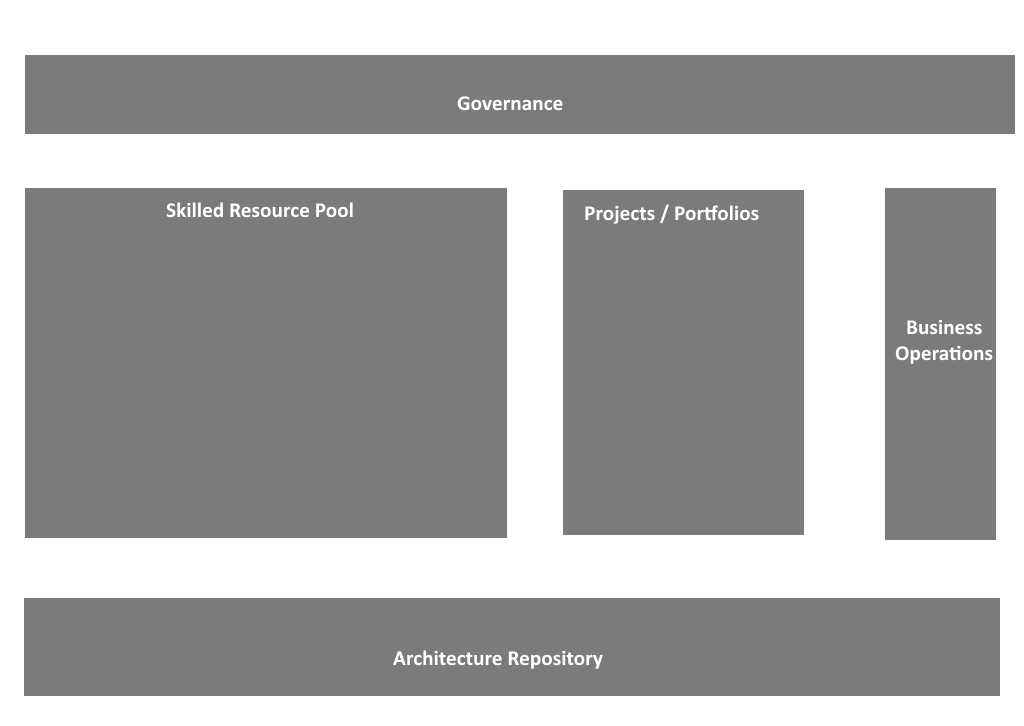
The ICL CMM mirrors the TOGAF CMM — it uses the same maturity scale and the same principle of assessing organizational capability across multiple dimensions. It is not a fork or a replacement. The difference is scope: where TOGAF CMM focuses on the EA practice, the ICL CMM applies to the whole organization, using five structural elements that exist in every organization regardless of size, industry, or whether dedicated EA practitioners are present:
- Governance — decision-making authority, policies, and oversight
- Skilled Resource Pool — the people and competencies available to the organization
- Projects / Portfolios — how work is initiated, executed, and delivered
- Business Operations — the running business; day-to-day function and continuity
- Architecture Repository — the organizational knowledge base; decisions, patterns, principles, and records
Organization Maturity is assessed across these five elements. Each element is scored independently. The overall organization level is the lowest score across all five — a chain is as strong as its weakest link.
Maturity Levels
| Level | Name | Description |
|---|---|---|
| L0 | None | No recognizable structure in this element |
| L1 | Initial | Activity exists but is ad-hoc and person-dependent |
| L2 | Emerging | Processes being defined; inconsistently applied |
| L3 | Defined | Documented, standardized, consistently followed |
| L4 | Managed | Measured, monitored, actively controlled |
| L5 | Optimising | Continuous improvement embedded in normal operation |
The entry ticket to the ICL BPT methodology is L3 across all five elements.
An organization at L3 across all five elements has what the ICL ADM requires to function:
- Governance can host an Architecture Board with enforcement authority
- Skilled Resource Pool can produce and review architectural deliverables
- Projects / Portfolios can run a structured five-step ICL ADM wheel
- Business Operations engages with architectural decisions rather than bypassing them
- Architecture Repository holds and serves the artifacts each wheel produces
Below L3, one or more of these conditions fails — and the ICL ADM wheel stalls.
Characteristics
Each element has a set of observable characteristics used to assess its maturity level.
Governance
- Decision Authority — it is clear who makes which decisions and at what level
- Policy Existence — policies exist, are written down, and are known to those affected
- Compliance Enforcement — decisions and policies are actually followed; deviations are addressed
- Strategic Linkage — governance decisions visibly connect to business strategy
Skilled Resource Pool
- Role Clarity — roles are defined; people know what is expected of them
- Competency Awareness — the organization knows what skills it has and what it lacks
- Knowledge Retention — knowledge is not locked in individuals; it survives turnover
- Cross-functional Participation — people from different functions contribute to shared goals
Projects / Portfolios
- Initiation Process — projects are started through a defined process, not informally
- Scope and Ownership — each project has clear scope, owner, and success criteria
- Portfolio Visibility — leadership has a current view of all active work and priorities
- Delivery Consistency — projects deliver predictably; outcomes match intent
Business Operations
- Process Documentation — key operational processes are written down and followed
- Business-IT Engagement — business roles actively engage with technology decisions that affect them
- Outcome Measurement — operations are measured against defined business outcomes
- Continuity Awareness — the organization understands and manages operational risk
Architecture Repository
- Existence — a repository exists and has a known location
- Currency — content is kept up to date; outdated records are removed or flagged
- Accessibility — the right people can find and use what is in the repository
- Decision Traceability — architectural decisions are recorded with rationale, not just outcomes
Maturity per Element — Reference Table
| Element | L0 | L1 | L2 | L3 | L4 | L5 |
|---|---|---|---|---|---|---|
| Governance | No decisions | Reactive only | Being formalized | Documented and followed | Measured | Self-improving |
| Skilled Resource Pool | No role clarity | Individual heroics | Roles emerging | Defined and stable | Capacity managed | Continuously developed |
| Projects / Portfolios | No process | Projects start informally | Some structure | Consistent initiation and delivery | Portfolio actively managed | Optimised throughput |
| Business Operations | No documentation | Key-person dependent | Processes partially documented | Standardized and followed | Outcomes measured | Continuously optimised |
| Architecture Repository | Does not exist | Ad-hoc notes | Partially maintained | Current and accessible | Audited and governed | Actively curated |
Scoring
Assess each element independently on the L0–L5 scale using the characteristics above as evidence criteria. The organization’s ICL CMM level is the minimum score across all five elements.
Example: Governance=L4, Skilled Resource Pool=L3, Projects=L3, Business Operations=L2, Architecture Repository=L3 → Organization level: L2
This prevents high scores in one area from masking critical gaps elsewhere.