IRONCODELABS

Safe Passage to AI
LLM can lead to the Second-System Effect
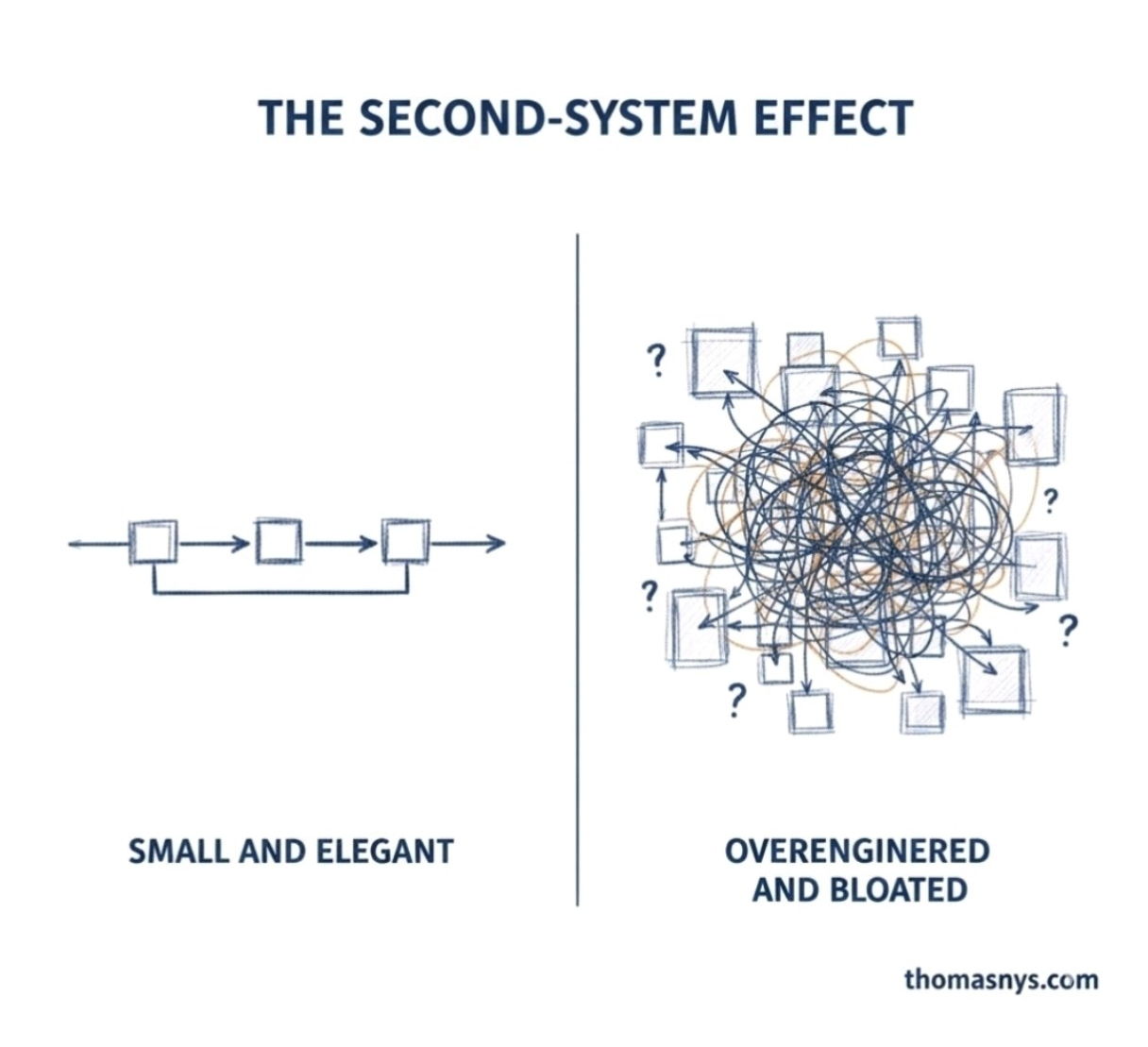
The classic Second-System Effect. Concept was articulated by Fred Brooks in The Mythical Man-Month (1975):
Fred Brooks: The second system a designer builds is the most dangerous.
What it means
- First system → constrained, pragmatic, minimal.
- Second system → “now we know better” → feature accumulation → abstraction layers → generalization → complexity explosion.
The image captures that perfectly:
- Left: pipeline, bounded, coherent.
- Right: graph-theory nightmare.
LLMs are complex and resource-heavy. Should that be avoided from the start?
Let’s analyze precisely.
1. Complexity source
LLMs are inherently:
- Exponentially slower with longer inputs.
- GPU-bound
- Latency-sensitive
- Memory-intensive
- Operationally non-deterministic
This is not accidental complexity. It is essential complexity of the LLM.
So the question is not:
“Are LLMs complex?”
They are. The question is:
“Is the (business) problem space complex enough to justify that complexity?”
Architectural Framing
When LLM is proposed as a solution, EA asks four questions — one per level:
- Conceptual level → What business capability is required?
- Logical level → What service pattern fulfills it?
- Physical level → What infrastructure hosts it?
- Implementation level → What concrete model / vendor?
If the required capability is any of:
- deterministic workflow
- structured data transformation
- rule evaluation
- search and retrieval
Then introducing an LLM is likely leading to second-system overreach. Its introduction will increase complexity, while the functionality can be solved with non-LLM tools.
If the required capability is any of:
- semantic inference
- unstructured reasoning
- language abstraction
- fuzzy decision support
Then LLM complexity may be justified. Pre-LLM tools and techniques would produce a more complex solution than an LLM-based one.
Architectural Framing is not a cook-book recipe. It requires adequate business domain and LLM domain expertise.
The Real Risk
The second-system effect with LLMs usually looks like:
- An LLM is added “just in case.”
- Orchestration is built around it.
- A vector DB is added.
- RAG is added.
- Prompt management is added.
- Evaluation pipelines are added.
- Guardrails are added.
- A research lab is now owned.
That is the right side of the picture above — the graph-theory nightmare, not the clean pipeline. A system started as a required capability solution and became a platform. The architecture now carries LLM infrastructure, orchestration dependencies, and operational overhead that were never scoped, never justified, and never governed.
Advisory to Avoid LLM Overengineering
If we want to avoid second-system syndrome with AI, we need to:
- Start with deterministic systems.
- If the problem can be solved with rules, workflows, or structured logic — solve it that way first.
- Introduce LLM only for solving a single bounded well-understood capability requirement.
- One problem, one justification, one integration point — not a general-purpose AI layer.
- Keep it behind a narrow interface (anti-corruption layer).
- The rest of the architecture should not know or care that an LLM is behind the interface.
- Measure actual business delta.
- Validate that the LLM produces measurable business value before expanding its scope.
- Do not build an AI platform before proven need.
- Platform investment follows proven capability — not the other way around.
In other words:
LLM should be a capability injection, not a platform foundation — unless the product itself is AI-native. Which legacy business system never is.
In a mature organization fighting legacy
Introducing LLM too early can:
- destabilize governance
- LLM outputs are non-deterministic — existing approval, audit, and compliance processes are not designed for that.
- bypass architecture discipline
- Teams integrate LLMs directly, skipping capability assessment, pattern selection, and review gates.
- create shadow IT
- Business units procure LLM services independently, outside of architecture and security oversight.
- inflate infrastructure cost
- GPU compute, vector storage, and API usage accumulate fast — often without a cost owner or budget line.
That is exactly how (Fred Brooks) second systems are born.
Bottom Line
LLM complexity should not be avoided by dogma. It should be avoided until justified by capability gap.
The mistake is not using LLMs. The mistake is:
Building the second system before business-validating the first one.
Reference: Fred Brooks — Second-System Effect
© dbj@dbj.org , CC BY SA 4.0